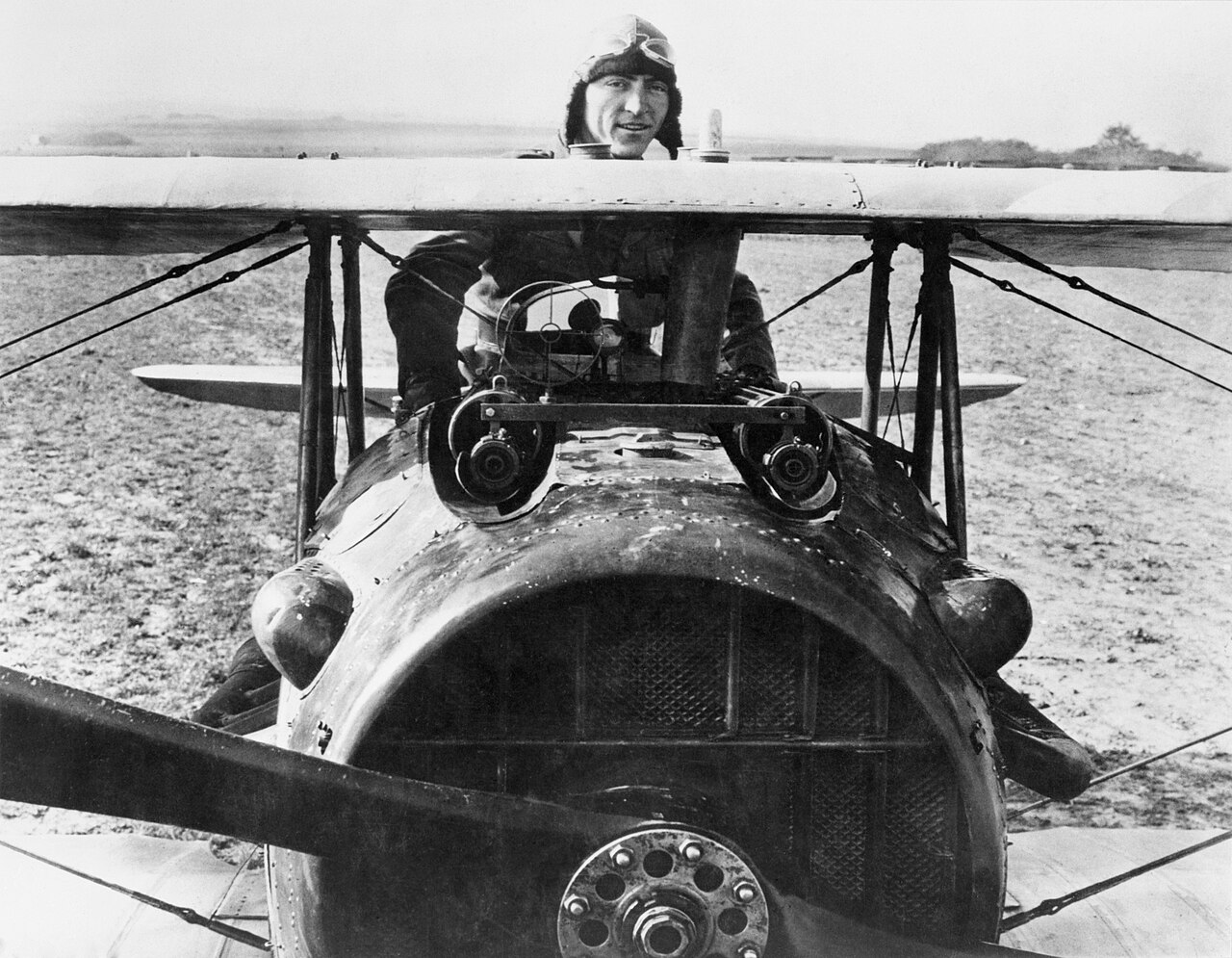
Eddie Rickenbacker
Top U.S. flying ace of World War I and racing driver.

Stanley Scott Collection · Public domain
Edward Vernon Rickenbacker (born Edward Rickenbacher, October 8, 1890 – July 23, 1973) was an American fighter pilot in World War I and a Medal of Honor recipient. With 26 aerial victories, he was the most successful and most decorated United States flying ace of the war. He was also a racing driver, an automotive designer, and a long-time head of Eastern Air Lines.
- born
- October 8, 1890, Columbus, Ohio
- died
- July 23, 1973
- nationality
- American
- known_for
- Top U.S. flying ace of World War I with 26 aerial victories; Medal of Honor reci
Verified Timeline
Lore & Background
Rickenbacker was born Edward Rickenbacher in Columbus, Ohio, the third of eight children to German-speaking Swiss immigrants, Lizzie and Wilhelm Rickenbacher. He later changed the spelling of his last name and adopted a middle name, Vernon. His father died on August 28, 1904, from injuries sustained in a brawl, passing away the same day or shortly after the incident. Rickenbacker dropped out of the seventh grade and went to work full-time, lying about his age to bypass child labor laws. He worked eight different jobs during the next two years. While at the Oscar Lear Automobile Company in 1905, he took an engineering course from the International Correspondence School. Chief engineer Lee Frayer took him under his wing, and Rickenbacker later followed Frayer to the Columbus Buggy Company as a chief testing engineer, supervising upwards of a dozen men at age sixteen. To draw attention to his company's car, Rickenbacker entered a 25-mile race in Red Oak, Iowa, crashing through an outer fence in his first race. He went on to win most dirt track races he entered, including five of six races at Omaha's Aksarben Festival in October. He later drove for the Duesenberg team, working sixteen-hour days at $3 a day developing a Mason race car. By 1915, he was a national racing figure earning the nickname 'Fast Eddie,' and finished the season ranked fifth among all racers with one victory. He adopted the middle initial 'V' after trying 26 different letters. During World War I, he became a fighter pilot, achieving 26 aerial victories and receiving the Medal of Honor.
Reader's Guide
Eddie Rickenbacker's significance lies in his dual achievements as America's leading World War I flying ace and as a pioneering figure in automobile racing and aviation business. His 26 aerial victories made him the most successful and most decorated United States flying ace of the war. He finished the 1915 season ranked fifth among all racers and was earning $40,000 a year. After the war, he applied his mechanical and managerial skills to automotive design and later became the long-time head of Eastern Air Lines. His life reflects the transition from early automotive innovation to the rise of air travel, and his rags-to-riches story—from a childhood of poverty, working before and after school, and accident-prone adventures like falling into a cistern and being rescued from a coal car twice—to national fame embodies the American spirit of perseverance and reinvention.
Did You Know?
- Rickenbacker was born Edward Rickenbacher, the third of eight children to German-speaking Swiss immigrants, and later changed the spelling of his last name and adopted a middle name, Vernon.
- As a child, he fell 12 feet into an open cistern and was rescued from a passing coal car twice by his brother.
- He dropped out of the seventh grade after his father died from a head injury in a brawl, lying about his age to work full-time.
- He earned the nickname 'Fast Eddie' as a racing driver and finished fifth in the AAA standings in 1915 with one victory.
- He adopted the middle initial 'V' after trying 26 different letters, and newspapers began spelling his name with a second 'k' more frequently in 1915.
A Boy Forged by Hardship in Columbus
Edward Vernon Rickenbacker entered the world in 1890 as Edward Rickenbacher, the third of eight children of German-speaking Swiss immigrant parents in Columbus, Ohio. His father Wilhelm labored for breweries and street-paving crews while his mother Lizzie took in laundry to supplement the household. The family built a small dwelling on East Livingston Avenue that had no running water, indoor plumbing, or electricity. Young Edd, as his parents called him, shouldered real duties from an early age—tending the garden of potatoes, cabbages, and turnips, caring for the family's chickens, goats, and pigs, and earning money through paper delivery and selling scavenged goods. He turned over the bulk of his pay to his mother. His childhood was punctuated by a string of near-fatal accidents: tumbling twelve feet into an open cistern, being pulled from a passing coal car twice by his brother, and nearly perishing in a burning school building. Decades later, while producing his autobiography, he came to believe God had repeatedly saved him for a higher purpose. His father's death in 1904, after being struck in the head with a level during a brawl, forced the sixteen-year-old to leave school and hunt for work to replace the lost family income.
Rise Through the Automotive World
After dropping out of the seventh grade, Rickenbacker lied about his age to sidestep child labor laws and cycled through eight different jobs in two years. A turning point arrived at the Oscar Lear Automobile Company in 1905, where he took a correspondence engineering course and caught the attention of chief engineer Lee Frayer, who handed him growing responsibility in the workshop. When Frayer moved to the Columbus Buggy Company, the sixteen-year-old followed as chief testing engineer, supervising a dozen or more men. His mechanical acumen and relentless work ethic impressed Harvey S. Firestone, who assigned him to special tasks including troubleshooting in Atlantic City and demonstrating at the 1909 Chicago Automobile Show. By eighteen, Rickenbacker was simultaneously chief engineer, experimenter, demonstrator, mechanic, and salesman at Columbus Buggy's Dallas agency. He even chauffeured the visiting William Jennings Bryan, earning newspaper attention that translated into three car sales. In March 1910, at just nineteen, Firestone sent him to direct the Upper Midwest Agency out of Omaha, overseeing sales, distribution, and maintenance across four states for a weekly salary of $125.
The Racing Years and the Indianapolis 500
To generate publicity for his employer's automobile, Rickenbacker entered a twenty-five-mile race in Red Oak, Iowa, only to crash through an outer fence and fail to finish. That same summer he dominated the dirt-track circuit, winning five of six races at Omaha's Aksarben Festival. Newspaper reporters repeatedly misspelled his name—Reichenbaugh, Reichenbacher, Reichenberger—before finally settling on Rickenbacker. In 1911, Frayer invited him to the inaugural Indianapolis 500, where Rickenbacker served as relief driver, covering the majority of the miles and helping his former boss finish thirteenth. The following year he drove Frayer's Red Wing Special solo but was forced out after one hundred miles by mechanical trouble. He then quit his sales position and joined the county fair circuit with a Flying Squadron team. In October 1912, the American Automobile Association imposed a twelve-month ban on drivers with histories of flouting safety rules, and Rickenbacker was among those barred. He spent the following year in the Des Moines, Iowa workshop of Frederick and August Duesenberg, deepening his mechanical expertise away from the track.
The Ace, the Aviator, and the Legacy
Rickenbacker's name became synonymous with aerial combat in the First World War. With twenty-six aerial victories, he stood as the most successful and most decorated United States flying ace of the conflict, earning the Medal of Honor for his service. Yet his identity stretched far beyond the cockpit. He was a racing driver who had competed at the Indianapolis 500 and on the county fair circuit, an automotive designer, and a long-time head of Eastern Air Lines, carrying his passion for flight into the commercial aviation era. Born Edward Rickenbacher to Swiss immigrants, he later changed the spelling of his surname and adopted the middle name Vernon, a small act of self-reinvention that mirrored his broader trajectory. The boy who once tried to launch a bicycle fitted with an umbrella off a barn roof, who built pushcarts with the Horsehead Gang as a precursor to the Soapbox Derby, and who nearly died in a burning schoolhouse, grew into a figure whose career spanned the automobile industry, the racetrack, the skies over Europe, and the boardroom of a major airline.
Gallery
Frequently Asked Questions
Who is Eddie Rickenbacker?
Edward Vernon Rickenbacker was an American fighter pilot in World War I who later became a well-known figure in racing, automotive design, and commercial aviation. Born in Columbus, Ohio in 1890, he is best remembered as the top-scoring U.S. flying ace of the Great War.
How many aerial victories did Eddie Rickenbacker claim?
Rickenbacker was credited with 26 confirmed aerial victories, making him the highest-scoring American fighter pilot of World War I. That record earned him the Medal of Honor and turned him into a national celebrity after the armistice.
What was Eddie Rickenbacker's specific role in World War I?
He flew as a combat pilot in the U.S. Army Air Service, serving with the 94th Aero Squadron before rising to command the 4th Pursuit Group. His combination of personal skill and unit leadership made him the most decorated American aviator of the conflict.
What did Eddie Rickenbacker do after World War I?
He transitioned into civilian life as a racing driver and automotive designer before taking on the presidency of Eastern Air Lines, a role he held for many years. He remained a visible public figure until his death in 1973.
Why is Eddie Rickenbacker considered important in U.S. military history?
As the top U.S. ace of World War I and a Medal of Honor recipient, he embodied the birth of American air combat power during the Great War. His later leadership in commercial aviation also helped shape the early growth of the U.S. airline industry.
More in Military Commanders Of The World Wars 1-24
Spotted an error? Know more?
This is a living reference — every entry is fact-audited, and reader corrections feed straight into our audit queue. Suggest an edit · See this site's audit record