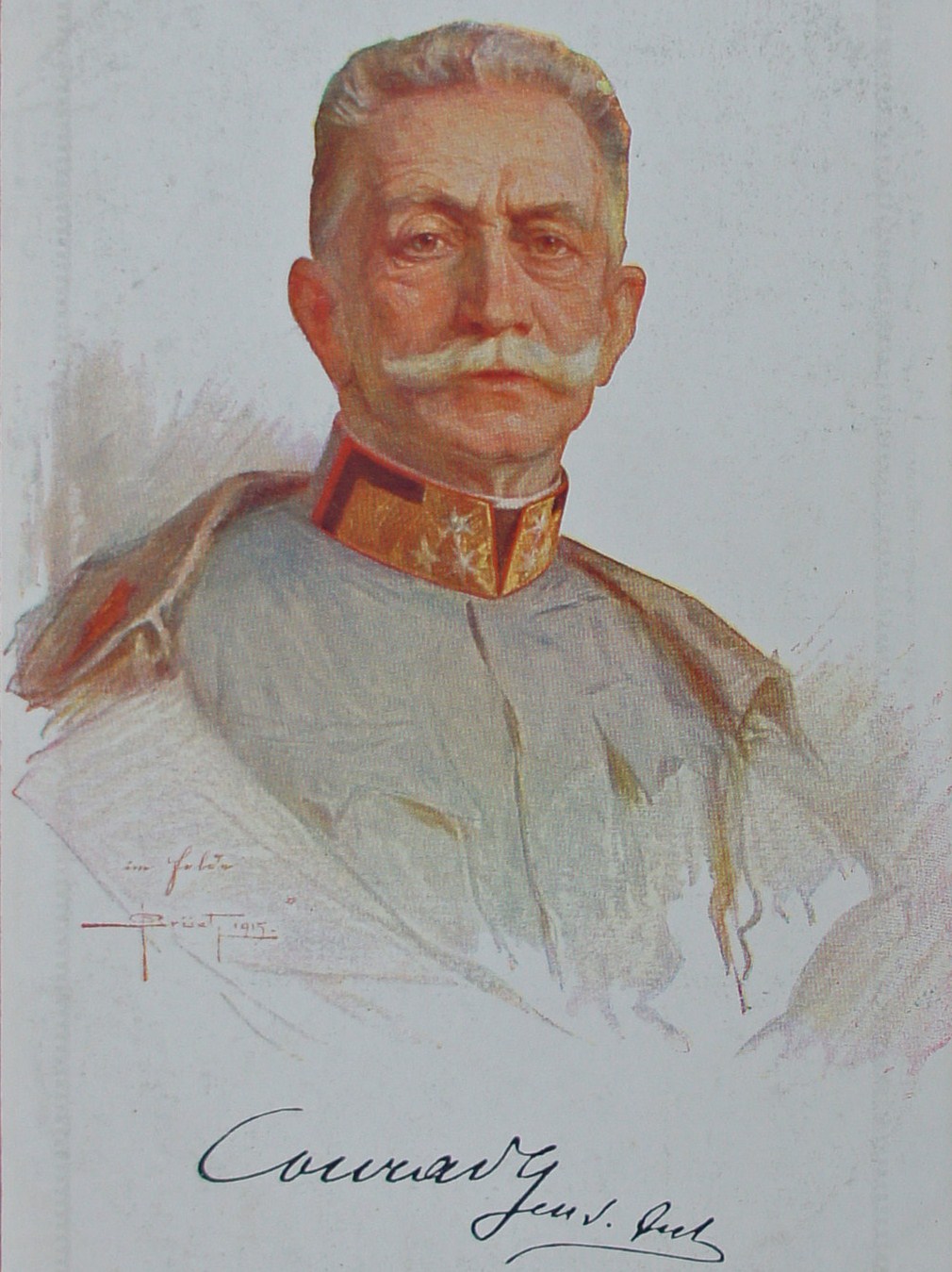
Franz Conrad von Hötzendorf
Austro-Hungarian general who shaped the July Crisis and World War I.

Oskar Brüch · Public domain
He served as K.u.k.
- field
- Military command and strategy
- nationality
- Austrian
- known_for
- Chief of the General Staff of Austro-Hungarian forces during World War I; advocate of preventive war against Serbia
Lore & Background
Conrad was born in Penzing, a suburb of Vienna, to an Austrian officers' family. He saw duty in Bosnia and Herzegovina and Dalmatia, later becoming a professor of military tactics at the Kriegsschule.
Reader's Guide
Conrad von Hötzendorf's significance lies in his central role in the outbreak and conduct of World War I. He was unaware that Germany would relocate most of its forces to the Eastern Front rather than the Balkans. His strategic thinking, shaped by Social Darwinism and a belief that war was inevitable, influenced government decision-making but also left the army unprepared for a two-front war.
Did You Know?
- He kept his war plans secret from his own diplomatic and political leadership, promising quick victory.
- He was a Social Darwinist who believed life consisted of 'an unremitting struggle for existence'.
Strategic Philosophy and the Call for Preemptive War
Conrad von Hötzendorf occupied a distinctive place in the strategic thought of early twentieth-century Europe. Rejecting the Clausewitzian notion that war was merely an extension of political policy, he regarded armed conflict as an inevitability that no amount of diplomacy could prevent. In his view, politicians and diplomats served only one purpose: to set the stage for military success. The destinies of nations and dynasties, he insisted, were settled not in conference halls but on the battlefield. This conviction drove him, for years, to press repeatedly for a preemptive strike against Serbia, which he saw as the existential threat to the multiethnic Austro-Hungarian Empire. He believed the Dual Monarchy was sliding toward disintegration and that only decisive military action could halt the process. When the July Crisis of 1914 finally erupted, Conrad felt the empire had acted at the eleventh hour. He was unaware that Germany intended to shift the bulk of its forces to the Eastern Front rather than the Balkans, a miscalculation that haunted the campaign. His willingness to leverage political pressure to advance his military agenda marked him as a visionary and a controversial figure within the Habsburg establishment.
Command in the Great War and the Erosion of Autonomy
From 1906 until his dismissal in March 1917, Conrad directed the General Staff of the Austro-Hungarian Army and Navy, placing him at the helm during the most consequential military crisis of his era. The opening months of the war were harrowing: Russian forces seized the Carpathian passes and threatened Hungary, while Italy simultaneously entered the conflict on the Allied side. The tide turned in the summer of 1915, when the combined Austro-German Gorlice-Tarnów Offensive swept through Galicia and Poland, and by October the allied forces, bolstered by Bulgarian entry, overran Serbia. Yet even these victories came at a cost. From 1915 onward, Conrad's armies grew increasingly dependent on German support and, in many cases, German command. Without that external lifeline, the Austro-Hungarian force was an exhausted and depleted army. His final major operation, the Trentino Offensive, failed to reach its objectives. Following the death of Emperor Franz Joseph I, the new sovereign, Charles I, removed Conrad from his staff position in March 1917. He then assumed command of an army group on the Italian Front before retiring in the summer of 1918.
A Private Life of Passion and Suffering
Behind the uniform and the strategic memoranda lay a man of intense private emotion. Conrad was born in Penzing, a Viennese suburb, into a military family; his father had been a Hussar colonel wounded while suppressing the 1848 Vienna Uprising. He married Wilhelmine le Beau in 1886, and together they raised four sons. Her death in 1905 plunged him into severe, recurring bouts of depression and deepened his persistent doubts about his own fitness for high office, a vulnerability he shared with his German counterpart von Moltke the Younger. In 1907, at a dinner in Vienna, he met Virginia von Reininghaus, an Italian aristocrat who was already married with six children. He became immediately and passionately enamoured, pursuing her despite the social impossibility of their situation. Their affair endured until they married in 1915. After his death in 1925, a journal called 'Diary of my Sufferings' was discovered, containing over three thousand letters he had written to Reininghaus—some exceeding sixty pages—detailing the depth of his love. He had kept them all in secret, never sending a single one, to shield both of them from scandal.
Education, Teaching, and the Making of a Thinker
Conrad's intellectual formation set him apart from many of his contemporaries. He entered the cadet corps at the Hainburg garrison and then attended the Theresian Military Academy in Wiener Neustadt, where he developed a keen interest in natural science, particularly Charles Darwin's theory of evolution. Commissioned as a lieutenant in a Jäger battalion in 1871 at nineteen, he graduated from the Kriegsschule in 1876 and joined the General Staff Corps. Early postings took him to the Ottoman provinces of Bosnia and Herzegovina and Novi Pazar under Austrian military administration, and he served as a staff officer during the 1882 Dalmatian insurrection. By 1888, promoted to major, he became a professor of military tactics at the Kriegsschule in Vienna, having prepared for the role by touring the Franco-Prussian War battlefields. He later returned to regimental command, rising to lead divisions in Innsbruck and Trieste. By the time Archduke Franz Ferdinand recommended him for the Chief of Staff post in 1906, Conrad had built a reputation not as a battlefield commander—he had little direct combat experience—but as a prolific writer and tireless advocate for modernizing the armed forces, whose published works on infantry tactics ran through multiple editions.
Gallery
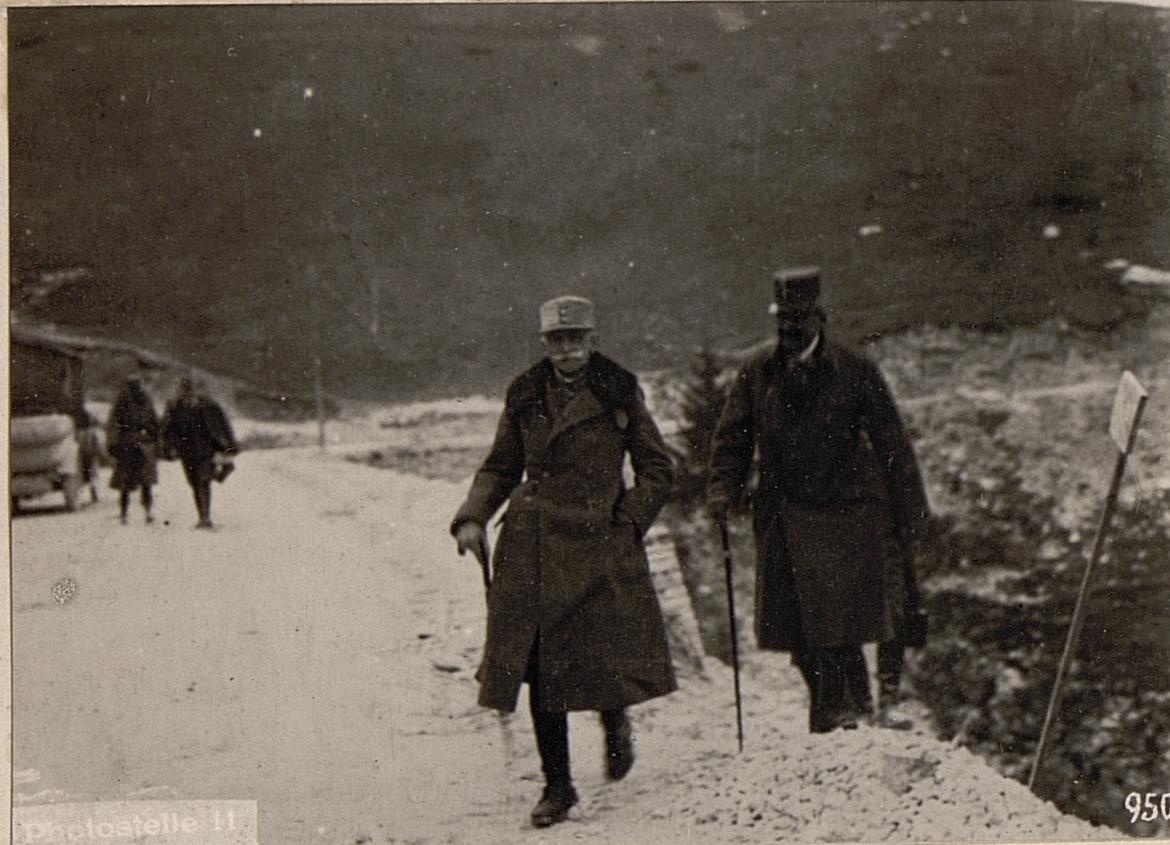
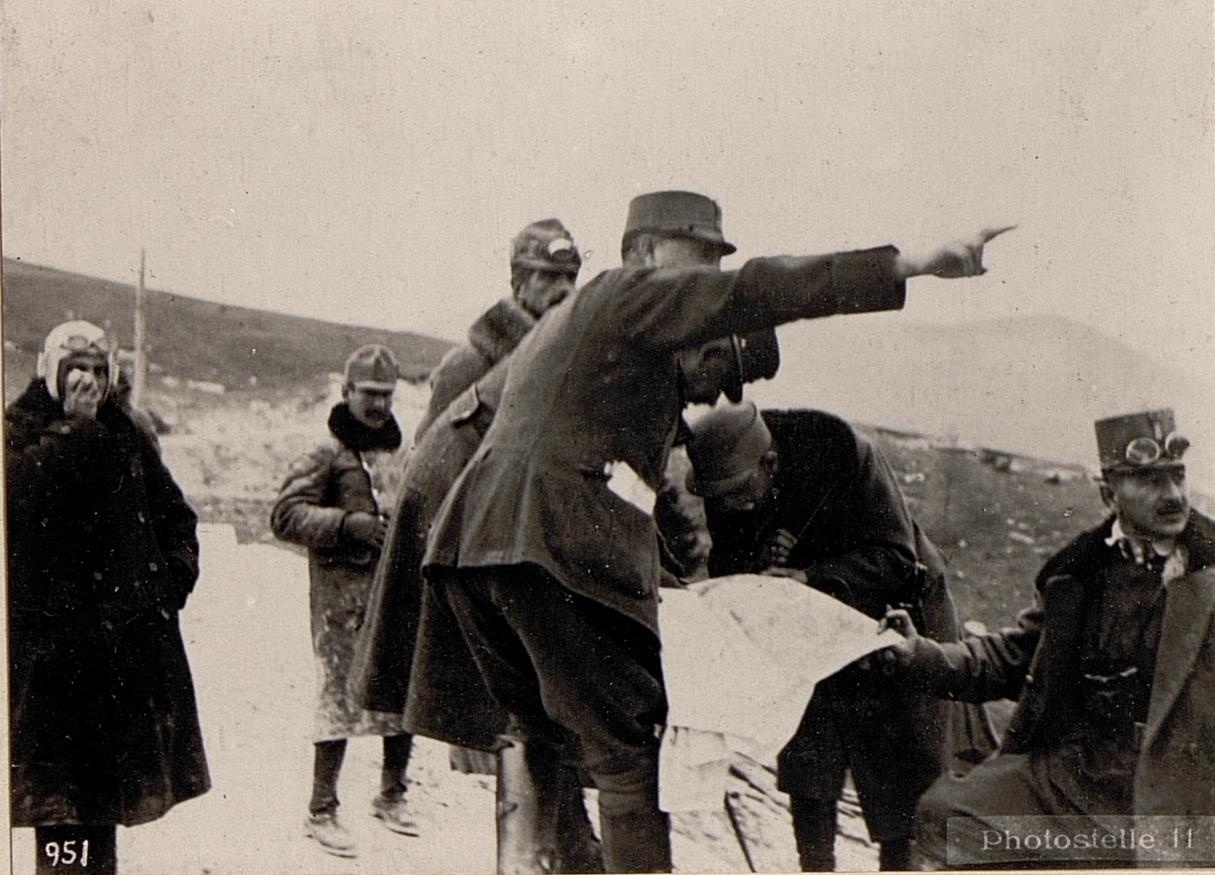
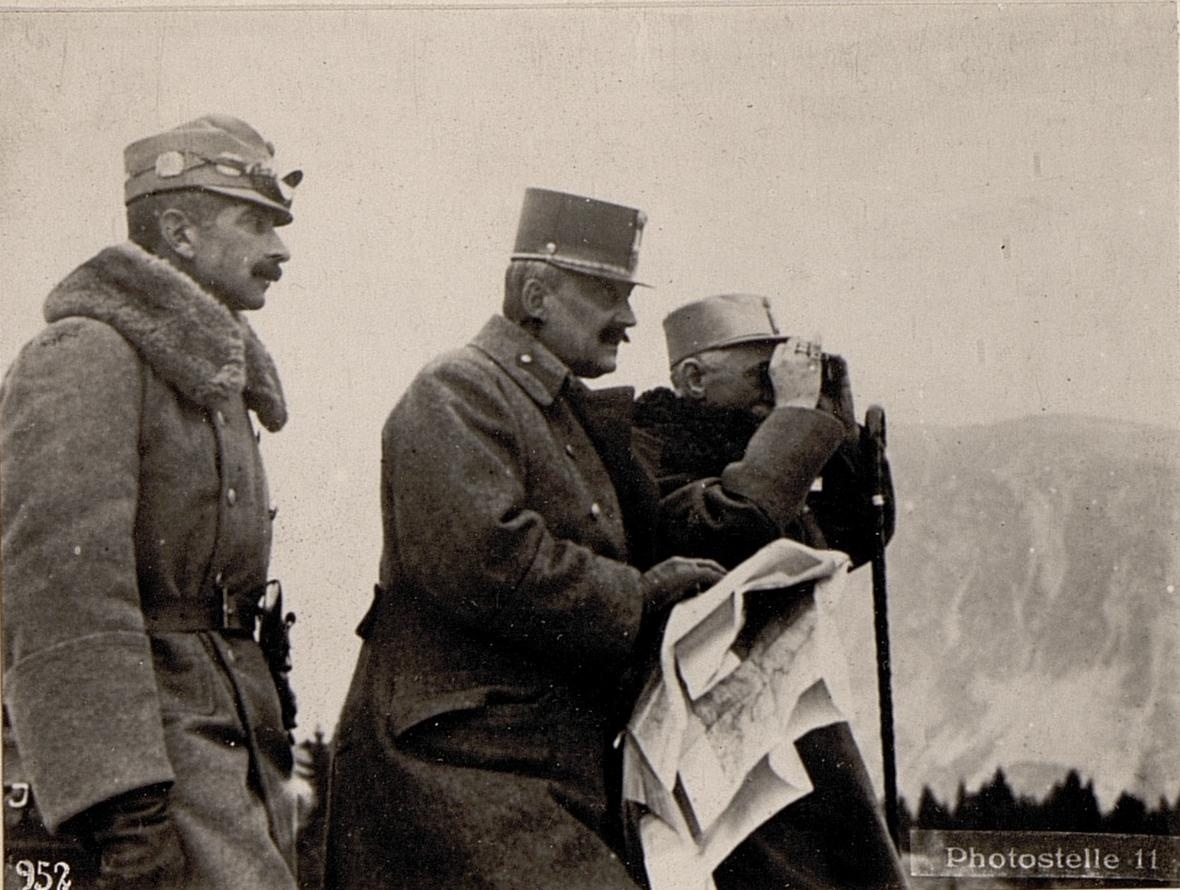
Frequently Asked Questions
Who is Franz Conrad von Hötzendorf?
He was an Austrian general who held the top staff position in the Austro-Hungarian military at the outbreak of World War I. He is best remembered as the Chief of the General Staff who pushed the empire toward a preventive war against Serbia.
What was Franz Conrad von Hötzendorf's role in World War I?
He served as the head of the Austro-Hungarian General Staff, making him the principal military strategist and planner for the empire's armed forces. In that capacity he was responsible for drafting the operational plans that governed Austria-Hungary's early war campaigns.
What is Franz Conrad von Hötzendorf most known for?
He is widely recognized for his persistent advocacy of a preventive strike against Serbia, a position he lobbied for over many years before the July Crisis of 1914. His pressure on political leaders is often cited as a key factor in pulling the empire into the wider conflict.
Why is Franz Conrad von Hötzendorf important to military history?
His strategic decisions and political maneuvering during the summer of 1914 helped shape the chain of events that escalated the Balkan crisis into a full-scale European war. He is therefore studied as a figure whose actions directly influenced the opening phase of World War I.
How did Franz Conrad von Hötzendorf's wartime career end?
Following the disastrous early defeats on the Galician and Trentino fronts in 1914, he was relieved of his command and replaced by General Arthur Arz. He retired from active military service and spent the remainder of the war in a largely private capacity.
More in Military Commanders Of The World Wars 1-24
Spotted an error? Know more?
This is a living reference — every entry is fact-audited, and reader corrections feed straight into our audit queue. Suggest an edit · See this site's audit record